Report
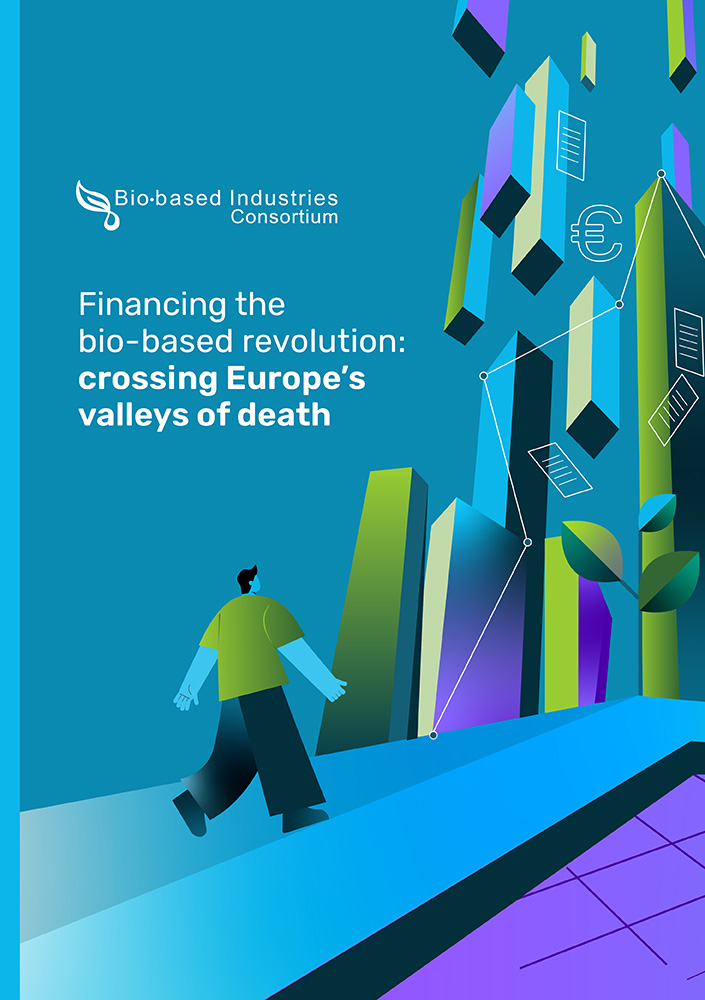
Financing the bio-based revolution: crossing the valleys of death
In this policy brief, we outline the potential biomanufacturing represents for Europe's bioeconomy if only the financing problems can be overcome.
EXECUTIVE SUMMARY
The global bioeconomy is valued at €2.3 trillion and represents 8% of the workforce , offering Europe a unique opportunity to assume a leadership role if it can achieve industrial-scale growth. Unlocking this potential would not only strengthen the Union’s competitiveness but also generate substantial socioeconomic benefits. Estimates suggest that by 2030, the EU could create up to one million new jobs in bio-based industries alone and help to achieve Europe’s climate and environmental goals.
The EU bioeconomy forms an industrial eco-system to develop products, tools, and processes at commercial scale, the so called “biomanufacturing” . Biomanufacturing has the potential to establish Europe as a hub of industrial innovation, reduce reliance on fossil fuels, drive competitiveness, and support the transition toward a sustainable bioeconomy. Yet, realising this potential requires significant investment from both public and private sources. This paper identifies the barriers currently impeding investment and possible concrete actions to unlock growth.
Despite Europe’s strong track record in research and development, scaling up remains a formidable challenge. High capital costs for constructing production facilities, difficulties in accessing finance for scale-ups, and protracted approval processes all weigh heavily on potential investors. In addition, weak market incentives for bio-based products make it harder for companies to demonstrate a viable return on investment. Together, these factors have created persistent financing gaps.
At present, biomanufacturing investment in Europe is hindered by two critical “valleys of death.” These represent stages in the innovation and commercialisation pathway where financing is most difficult to secure, and where promising technologies are at risk of stalling. Reducing investment risk and mobilising capital — particularly venture financing — will be essential if Europe is to bridge these valleys, especially the second, which is most acute during the scale-up and production phases.
This challenge is compounded by Europe’s relative underperformance compared to the United States. Between 2008 and 2021, nearly 30 percent of European-founded “unicorns” — startups that achieved a valuation above USD 1 billion — relocated their headquarters abroad, with most moving to the US . This migration underscores the difficulties faced by European firms in securing sufficient funding and scaling opportunities at home.
Addressing these barriers requires a concerted policy effort to reduce investment risks and strengthen financial support, particularly for the scale-up and production phases of biomanufacturing. Mobilising both public investment and venture and private (equity) capital will be vital to close Europe’s financing gap. Only by doing so can the EU capture the full promise of the global bioeconomy and position itself as a global leader in this rapidly expanding sector.
This report provides a concise list of the actions we have identified that could be undertaken to improve access to finance for biomanufacturing in Europe, such as:
-
improve awareness and accessibility of existing financial instruments
-
continue the CBE JU public-private partnerships under the new EU budget (2028-2034)
-
leverage 1st of its kinds project, including CBE JU flagship projects under the European Competitiveness Fund and other EU funding instruments
-
animate a network of funding suppliers and guide projects seeking funding
-
facilitate a more coordinated, blended use of current risk-sharing instruments
-
improve market framework conditions
-
commit additional public funds and risk-sharing instruments
-
sharpen investment regulations and mobilise pension funds
This report outlines why these specific actions are needed and provide further details on the targeted actions themselves.
Click the green button above to download the full report.